


If you’ve been following travel news lately, you’ve probably come across the phrase “Europe freezes US travel” more than once. It’s been circulating on social media, in travel blogs, and in news headlines, sparking confusion and concern among Americans planning trips abroad. But what does it really signify, and should you be concerned?
The short answer is that Europe has not banned Americans from visiting. However, the longer answer is more nuanced. New digital border systems and travel authorisation requirements are changing how Americans enter Europe, making the process more structured and regulated than ever. For anyone planning a European trip in 2026, understanding these changes is essential.
This article breaks down the reality behind the claim that “Europe freezes US travel,” explains the new systems being introduced, and offers practical guidance on what to expect and how to prepare.
What Does “Europe Freezes US Travel” Actually Mean
The phrase “Europe freezes US travel” does not mean that American passports are suddenly invalid or that European borders are closed to US citizens. Rather, it reflects a significant shift in how Europe manages and monitors visitors from outside the European Union.
For decades, Americans could board a flight to Paris, Rome, or Barcelona with little more than a valid passport. No pre-registration, no online authorisation, no biometric scanning. That era is ending. Europe is rolling out two major systems, the Entry/Exit System and the European Travel Information and Authorisation System, that together represent the most significant overhaul of European border management in recent memory.
When people use the phrase “Europe freezes US travel,” they are largely describing this transition period, where new requirements, new technology, and new procedures are converging at once. Travel is not frozen. It is being formalised.
New European Travel Rules Affecting US Travellers
The discussion around “Europe freezes US travel” has intensified because the rule changes are real, concrete, and happening now. Here is what American travellers need to understand.
Major Changes Travellers Should Know
- The Entry/Exit System (EES) now collects biometric data, including fingerprints and facial images, from all non-EU visitors at external borders
- Fully digital border records are replacing traditional passport stamps
- All entries and exits are tracked electronically across participating European countries
- The 90-day stay limit within any 180 days is being monitored automatically through the digital system
- Border technology at airports, seaports, and land crossings is being upgraded to support this new infrastructure
The Entry/Exit System began operations on October 12, 2025, according to the official EU travel authority. European countries are gradually introducing the system at their external borders, with full implementation expected by April 10, 2026. This phased rollout means that some border points are already operating the new system while others are still transitioning.
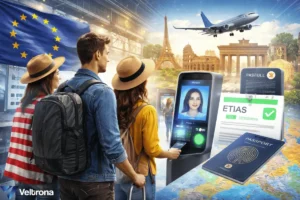
Biometric data collected under the EES includes your facial image and fingerprints, along with standard information from your travel documents, the dates and places of each entry and exit, and any records of refused entry. Refusing to provide biometric data at the border means you will be denied entry into the country. There is no opt-out.
The Entry/Exit System: What It Means at the Border
One of the biggest practical changes driving the “Europe freezes US travel” conversation is the shift away from passport stamps. For generations of travellers, a stamped passport was both a souvenir and a record. A centralised digital database is now replacing that.
Every time a non-EU visitor crosses into or out of a participating European country, the system logs the entry or exit. This creates a comprehensive travel record that border authorities can access instantly. The goal is to make border checks faster and more accurate, while also making it much harder for travellers to overstay their permitted time in Europe.
For Americans, this means that the informal nature of previous trips is gone. The 90-day rule, which allows non-EU visitors to stay in the Schengen Area for up to 90 days within any 180 days, is now actively enforced through real-time digital tracking rather than manual passport checks.
ETIAS Travel Authorisation Coming for Americans
Beyond the Entry/Exit System, the “Europe freezes US travel” debate has also been fueled by the upcoming launch of ETIAS, the European Travel Information and Authorisation System. According to the official EU ETIAS website, ETIAS will start operations in the last quarter of 2026.
Key Facts About ETIAS
- Americans will need to apply for online travel authorisation before travelling to around 30 European countries in the Schengen Area
- The application is completed online and linked directly to your passport
- The application fee is EUR 20
- Approved travellers can stay for up to 90 days per visit
- Authorisation is expected to remain valid for multiple trips over several years
ETIAS works similarly to the US ESTA system, which visa-exempt visitors use to enter the United States. It is not a visa. It is a pre-travel security check that allows European authorities to screen travellers before they arrive at the border.
The EU has confirmed that the specific launch date will be announced several months before ETIAS goes live. No action is required from travellers right now, but it is important to monitor updates as 2026 progresses.
Why Europe Is Tightening Travel Rules
Understanding why “Europe freezes US travel” has become such a prominent phrase requires some context about broader global trends in border management.
European governments are responding to the same pressures that have driven countries such as Australia, Canada, and the United States to introduce digital travel authorisation systems of their own. These include concerns about irregular immigration, identity fraud, overstays, and the challenges of efficiently managing high volumes of international travellers.
Digital border systems like the EES allow authorities to identify travellers who have exceeded their permitted stay, detect individuals using fake identities or forged documents, and support law enforcement investigations when necessary. The shift to biometric data makes it significantly harder to enter Europe under pretences.
For most legitimate travellers, these systems are designed to be seamless. Data is collected quickly at the border, and the ETIAS authorisation process is expected to be straightforward for the vast majority of applicants.
How These Changes Impact American Travellers
The “Europe freezes US travel” narrative has understandably created anxiety, but the practical impact for most Americans will be manageable if they prepare properly.
Some airports may experience longer processing times during the initial rollout of the Entry/Exit System as border staff adjust to new procedures and equipment. Over time, digital processing is likely to be faster than the old manual stamp-and-check system.
For ETIAS, Americans will need to apply online before booking or at least before travelling, similar to how non-US citizens apply for ESTA before visiting the United States. The process is expected to take only a few minutes for most applicants, with approval often granted quickly.
Tips for Americans Planning Travel to Europe
Given the scale of the changes behind the “Europe freezes US travel” conversation, here is practical guidance for anyone planning a European trip in 2026 or beyond:
- Check your passport validity well before booking, as many countries require at least six months of validity beyond your travel dates
- Monitor the official EU ETIAS website for the confirmed launch date and apply as soon as the system opens
- Allow extra time at airports during border checks, particularly at busy international hubs in the early months of full EES implementation
- Familiarise yourself with the 90-day Schengen rule and use the EU’s short-stay calculator to track your permitted days
The Real Picture Behind “Europe Freezes US Travel”
The phrase “Europe freezes US travel” is more headline than reality. Americans are not being banned from Europe. The continent remains one of the most visited destinations in the world for US travellers, and that is not changing.
What is changing is the infrastructure behind how travel is managed. The Entry/Exit System and ETIAS represent a fundamental modernisation of European border control, bringing it in line with similar systems already in place in countries such as the United States and Australia. Digital records, biometric verification, and pre-travel authorisation are replacing the days of passport stamping and manual checks.
For travellers who stay informed and prepare in advance, these changes will be minor adjustments. The goal is not to get caught off guard. Follow official EU travel updates, check authorisation requirements before you fly, and make sure your travel documents are in order. Europe is still open for business. It just has a new door policy.