
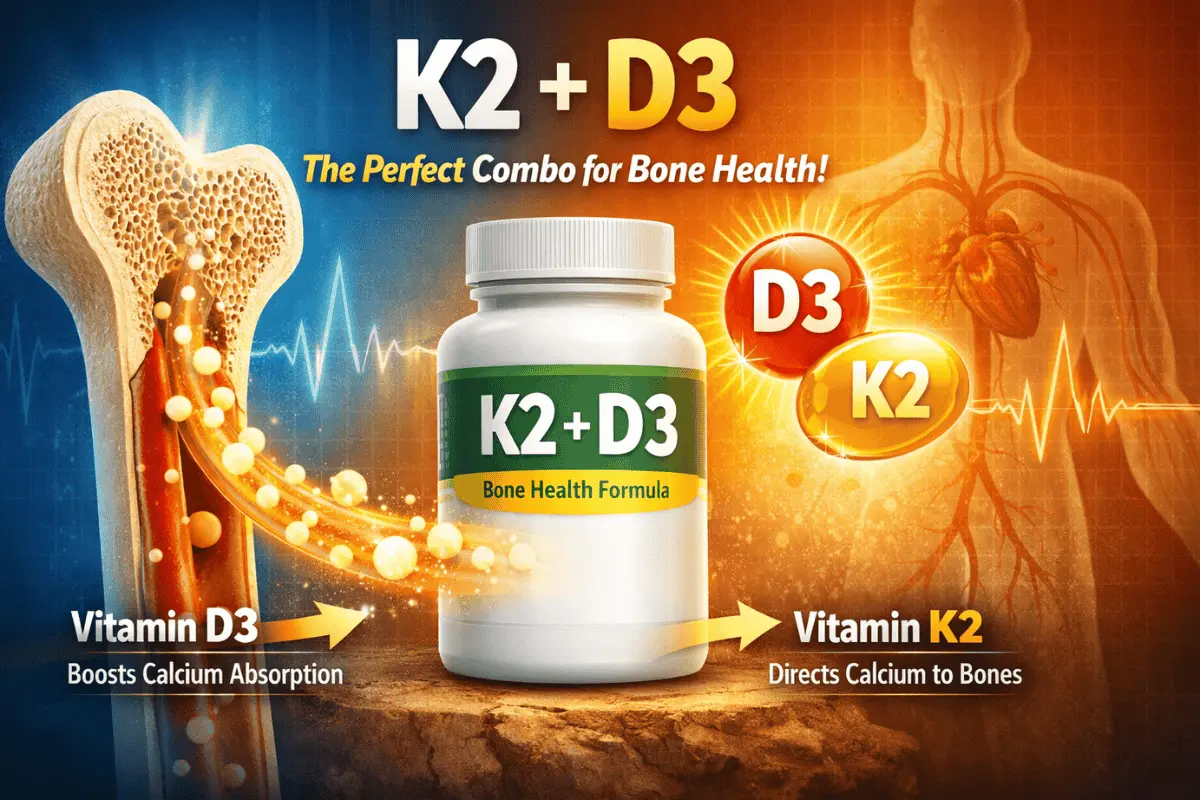

Calcium gets most of the credit for strong bones. But without the right supporting nutrients, your body struggles to put that calcium where it actually belongs. A K2 D3 vitamin supplement brings together two nutrients that work as a team: Vitamin D3 pulls calcium into your bloodstream, while Vitamin K2 makes sure it ends up in your bones rather than your arteries. Understanding how these two vitamins interact helps explain why so many bone health formulas now combine them.
What Is a K2 D3 Vitamin Supplement?
A K2 D3 vitamin supplement is a combined formula containing two fat-soluble vitamins that play complementary roles in calcium metabolism and bone strength.
Vitamin D3 (cholecalciferol) is the form of vitamin D your skin produces when exposed to sunlight. It is also the form most commonly used in supplements. It is considered more effective at raising blood levels of vitamin D than D2 (ergocalciferol), according to the NIH Office of Dietary Supplements.
Vitamin K2 (menaquinone) is a form of vitamin K found in fermented foods and animal products. Unlike vitamin K1, which is abundant in leafy greens and mainly supports blood clotting, vitamin K2 plays a more direct role in bone and vascular health. The most studied form in supplements is MK-7 (menaquinone-7), which stays active in the body longer and reaches tissues beyond the liver more effectively than other forms.
These two nutrients are increasingly sold together because their functions are closely linked: D3 raises calcium absorption, and K2 controls where that calcium is deposited.
How Vitamin D3 Supports Bone Health
Vitamin D3’s main role in bone health is to help your digestive system absorb calcium from food. Without adequate vitamin D, much of the calcium you consume simply passes through your body unused.
Beyond absorption, vitamin D helps regulate blood calcium levels. When blood calcium drops too low, the body compensates by pulling calcium from bones, which gradually weakens them over time. Getting enough vitamin D3 helps prevent this from happening.
According to the NIH, adults up to age 70 need 600 IU (15 mcg) of vitamin D per day, while those over 70 need 800 IU (20 mcg). Blood levels below 30 nmol/L (12 ng/mL) are considered too low and can affect bone health, while levels above 125 nmol/L (50 ng/mL) may cause harm.
How Vitamin K2 Works With Vitamin D3
This is where the synergy becomes clear. Once vitamin D3 boosts calcium absorption, more calcium circulates in the body. Without proper regulation, some of that calcium can deposit in soft tissues and blood vessels rather than bones.
Vitamin K2 activates two key proteins:
- Osteocalcin, a protein produced by bone-building cells that binds calcium to the bone matrix. Osteocalcin works properly only after it has been carboxylated (activated) by vitamin K2. Research published in peer-reviewed journals shows that MK-7 supplementation at 100 mcg/day significantly improves osteocalcin carboxylation, supporting bone mineralisation.
- Matrix Gla Protein (MGP), which acts as a natural inhibitor of calcium deposits in blood vessel walls. MGP requires vitamin K2 to become active. Without adequate K2, MGP remains inactive (undercarboxylated), allowing calcium to accumulate in arteries. As one review published in the International Journal of Molecular Medicine notes, “MGP was the first identified vascular calcification inhibitor, which combines with Ca/P to prevent its deposition in blood vessels.”
In short, vitamin K2 functions as a traffic director for calcium, steering it into bones and away from arteries.
Key Benefits of a K2 D3 Vitamin Supplement
Stronger Bones
The most well-documented benefit of combining K2 and D3 is improved bone density. A three-year study by Knapen et al. found that MK-7 supplementation at 180 mcg/day helped decrease bone loss in healthy postmenopausal women. D3 provides the calcium supply; K2 ensures it is incorporated into bone tissue.
Better Cardiovascular Health
By keeping calcium out of arterial walls, active MGP may help reduce the risk of vascular stiffness. Scientists are still studying this mechanism, but existing evidence suggests a connection between low vitamin K2 status and higher rates of arterial calcification.

Improved Calcium Utilisation
Taking large amounts of calcium without adequate K2 and D3 may not deliver the bone-strengthening results people expect. This combination helps ensure the body uses calcium efficiently, directing it to where it is actually needed.
Immune System Support
Vitamin D3 has a well-established role in immune function. According to the NIH, your immune system needs vitamin D to help fight off bacteria and viruses, making adequate intake relevant beyond just bone health.
Signs You May Need a K2 D3 Vitamin Supplement
Certain patterns may suggest low levels of these vitamins. These are not diagnostic criteria, but they are worth discussing with a healthcare provider:
- Frequent bone pain or unexplained muscle weakness
- Blood tests showing low 25-hydroxyvitamin D levels
- Limited sun exposure due to geography, lifestyle, or skin type
- Age-related concerns about bone density, particularly after menopause
- Diets low in fatty fish, dairy, or fermented foods
Recommended Dosage and Safety
Vitamin D3: The tolerable upper intake level for adults set by the NIH is 100 mcg (4,000 IU) per day from all sources combined. Signs and symptoms of toxicity are unlikely below 250 mcg (10,000 IU) per day, but the NIH advises avoiding blood levels above 125 to 150 nmol/L (50 to 60 ng/mL). Most standard K2 D3 supplements contain 1,000 to 2,000 IU of D3.
Vitamin K2 (MK-7): No tolerable upper intake level has been established for vitamin K, as no adverse effects from dietary or supplemental intake have been reported in healthy individuals, according to the NIH and the Linus Pauling Institute. Studies have used MK-7 doses ranging from 100 to 180 mcg daily.
Important note for anyone taking warfarin or other anticoagulants: Vitamin K directly affects how these medications work. Even relatively low daily doses of MK-7 can affect the stability of anticoagulants. The NIH advises people taking warfarin to keep their vitamin K intake consistent day to day and consult their doctor before making any changes. Do not start a K2 D3 vitamin supplement if you take blood thinners without medical guidance.
As with any supplement, it’s best to talk to a healthcare professional before starting, especially if you have existing health conditions or take prescription medications.
Natural Food Sources of Vitamin D3 and K2
Supplements work best when they complement a nutrient-rich diet. Here is where you can find these vitamins naturally:
Vitamin D3 food sources:
- Fish high in fat, such as mackerel, tuna, and salmon
- Egg yolks
- Beef liver
- Fortified milk, plant-based milks, and some breakfast cereals
- Sunlight exposure (your skin makes D3 when UV rays hit bare skin)
Vitamin K2 food sources:
- Natto (fermented soybeans), one of the richest sources of MK-7
- Hard and soft cheeses
- Egg yolks
- Chicken and beef liver
- Fermented dairy products
Vitamin K1 is easy to get from leafy greens like spinach and kale, but K2 specifically is harder to obtain in meaningful amounts from a typical Western diet, which is part of why supplements are popular.
Who Should Consider Taking K2 D3 Supplements
These groups are most likely to benefit from a K2 D3 vitamin supplement:
- Older adults, whose skin produces less vitamin D with sun exposure and who face greater risks of bone loss
- People with limited sun exposure, including those who work indoors, live in northern climates, or cover their skin for cultural or medical reasons
- Individuals with darker skin tones, as greater melanin reduces vitamin D synthesis from sunlight
- Postmenopausal women who experience accelerated bone density loss
- People with fat malabsorption conditions such as Crohn’s disease, celiac disease, or ulcerative colitis, as both vitamins are fat-soluble
- Those with confirmed low vitamin D levels on a blood test
Choosing the Right K2 D3 Vitamin Supplement
Not all supplements are equal. A few things to look for:
- MK-7 form of vitamin K2: This is the most bioavailable and longest-acting form. MK-7 produces plasma concentrations roughly five times higher than vitamin K1 at the same daily intake, according to research cited in peer-reviewed journals.
- Third-party testing: Look for products verified by independent organisations to confirm purity and accurate labelling.
- Appropriate D3 dosage: Most people do well with 1,000 to 2,000 IU per day unless a healthcare provider has recommended more to correct a deficiency.
- Fat-containing formulas or instructions to take with food: Both vitamins are fat-soluble and absorb better when taken with a meal that contains some fat.
Putting It Together
A K2 D3 vitamin supplement is not just a convenient two-in-one capsule. The combination reflects how these nutrients actually function in your body. Vitamin D3 brings calcium in; vitamin K2 puts it to work in the right place. Together, they support bone strength, healthy calcium metabolism, and potentially better cardiovascular outcomes.
If you are considering adding a K2 D3 vitamin supplement to your routine, speak with a healthcare provider first. A simple blood test for vitamin D levels can give you a clear baseline, and your doctor can recommend dosing that fits your individual needs rather than guessing.